
This Week:
- Ford Management
Appointments
. - Executive
Changes Announced At GM Powertrain
. - Toyota Donates $1 Million to National Underground Railroad Freedom Center
- A
New Way of Moving in Vietnam - From TH!NK
. - European
Commission Approves Volvo’s Aquisition Of Renault VI/MACK
. - Lear and Exide Join Forces to Integrate Advanced Electrical Power Into Vehicle Interior Systems
© 1998
- 2000 Copyright &
Disclaimer
Automotive Intelligence,
www.autointell.com
All Rights Reserved .
For questions please contact
editor@autointell.com

News of September
05, 2000
.
| Jaguar
XK Series advances the art of safety . |
|
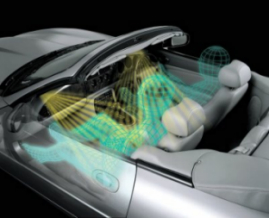
Jaguar's Adaptive Restraint Technology System Photo: Ford |
|
MAHWAH,
N.J. - With the release of the 2001 XK Series, Jaguar Cars becomes the
first automaker in the world to offer an advanced safety system using
ultrasonic sensing technology to provide occupant position data for
managing airbag deployment. Jaguar's Adaptive Restraint Technology
System (ARTS) is fitted as standard equipment on all XK Series sports
cars and is a key component of the car's enhanced safety features for
the 2001 model year. Operating
in concert with new head-and-thorax side-impact airbags, located in the
backrests of each front seat, and state of the art safety belt system,
ARTS establishes a new standard for intelligent occupant protection
technology. "By
taking on the challenge to develop this technology and bring it to
market, Jaguar further establishes its leadership position as a
technological innovator," says Mike O'Driscoll, president of Jaguar
North America. "The ARTS technology embodies Jaguar's philosophy of
delivering high performance in every area of our product
execution." ARTS
Matches the Action to the Situation The
all-new Adaptive Restraint Technology System uses ultrasonic sensing
technology to monitor the position of the front passenger, while a
separate array of sensors detects the front passenger's seated weight,
the position of the driver in relation to the steering wheel, the usage
of safety belts and, in the event of a collision, the severity of the
impact. Armed
with this information, ARTS regulates the deployment of the airbags for
each front seat occupant to a level appropriate to the specific
characteristics of an impact. The system is designed to help further
reduce the risk of injury to occupants related to inappropriate airbag
deployment, especially for smaller front-seat occupants. An added
benefit is the reduction of repair costs associated with the number of
airbag deployments, particularly when the passenger seat is unoccupied. Ultrasonic
Occupant Sensing System - A World First The
Jaguar XK Series is the only production car in the world to employ
ultrasonic occupant sensing technology. Four ultrasonic sensors, located
in the A-pillar, B-pillar and the new roof console determine the
presence and position of the front-seat passenger's head and upper torso
with respect to the passenger airbag deployment door. If
the passenger is too close to the dashboard, a warning light will
illuminate to indicate that the passenger airbag is inactive and would
not deploy in the event of an impact. As soon as the passenger moves far
enough away, within milliseconds the airbag becomes active again and the
light goes out. The ultrasonic sensors primarily monitor the position of
the passenger's head and torso, rather than the arms and hands, as the
proximity of the head and torso to the airbag deployment door is the
crucial factor in the systems' decision regarding deployment. While
the ultrasonic sensors constantly monitor the presence and position of
the front seat passenger, a weight sensor in the front passenger seat
detects the presence and approximate seated weight of the occupant --
another important factor in determining whether, and to what extent, the
airbag should be deployed. If the passenger seat is empty, the passenger
airbag is designed to not deploy. For
the driver, an electronic sensor in the seat track measures the distance
of the driver's seat from the steering wheel; and sensors in the driver
and front passenger safety belt buckles tell the system whether or not
the occupants are wearing safety belts. Meanwhile, crash sensors at the
front cross-member panel and at the sides of the car gauge the severity
of an impact. Each
sensor feeds information to the system's central processor, which
governs the use of safety belt pretensioners and the deployment of
dual-stage front airbags. The front airbags are inflated either at a
higher power or lower power, in accordance with occupant data and the
severity of the impact. Decisions can be computed in as little as 10
milliseconds. The decision-making ability of ARTS was developed using
Artificial Neural Network technology, an advanced programming technique,
and involved more than a half million possible impact scenarios. In
conjunction with the development of ARTS, a number of modifications have
been made to the XK Series body shell. These changes, which include
reinforced front side members, provide added rigidity and structural
integrity as well as enabling the crash sensors to be positioned so that
an impact is detected as quickly and accurately as possible. The
key features of ARTS are: The
world's first application of ultrasonic occupant sensing - for front
passenger Front passenger
seat weight sensor Driver's
seat track position sensor Front safety belt usage sensors Electronic
front- and side-impact sensors Driver and passenger front airbags with
dual level inflation Front seat-mounted side airbags, providing enhanced
protection for the head and rib cage in moderate to severe side impacts
Front safety belt load-limiters and pretensioners Star-fold pattern on
driver's airbag, featuring radial deployment to reduce the risk of
injury to drivers seated close to the wheel. (September
1, 2000) |
[Homepage] [
News] [ Companies] [
Management] [ Publications]
[ Events] [ Careers]
[Services] [Discussion] [
Guestbook]
[ Search]